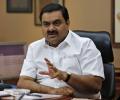
The clarification by the National Securities Depository (NSDL) - which is tasked with monitoring foreign portfolio investor (FPI) investment in domestic stocks - that the accounts of top investors in Adani group stocks remain 'active' has helped prevent a $500-million selloff of shares. Analysts said a freeze of the FPI accounts, as reported by some media outlets, could have prompted global index providers to cut weighting of four Adani group companies from their global indices. Brian Freitas, an analyst at independent research provider Smartkarma, said if the FPI accounts were indeed frozen, FTSE and MSCI would have reduced weighting of Adani group companies at the next rebalance, since it would have meant that the large part of the free float was not tradeable.

Easier dilution norms for mega initial public offerings (IPOs) have come into effect. Companies with post-listing market capitalisation (m-cap) of more than Rs 1 trillion will not be required to dilute a minimum of 10 per cent. The move to relax dilution norms is seen as a precursor to Life Insurance Corporation's IPO. The central government has said companies with an m-cap exceeding Rs 1 trillion will have to dilute Rs 5,000 crore and at least 5 per cent of their m-cap. Experts said the earlier framework discouraged large companies from listing since they were forced to offload a large volume of shares during the time of their IPO.
Most of the changes have come about in the last four years and ITC is now reaping the dividends - standalone revenues from the non-cigarettes FMCG business have grown 40 per cent from FY17 to Rs 14,728.21 crore in FY21 and pre-tax profits 30 times to Rs 823.69 crore. The business accounted for 30.58 per cent of gross revenues and 4.85 per cent of pre-tax profits in FY21. "In the last four years, our margins in FMCG have gone up by 640 basis points (bps) and EBITDA margins have been moving up consistently. "We created levers that enabled a sustained growth trajectory," said ITC chairman and managing director Sanjiv Puri. Puri took charge as the chief executive officer in 2017; in 2018, he was redesignated managing director and effective May 2019, he became chairman.

The Securities and Exchange Board of India (Sebi) has directed Franklin Templeton MF to pay Rs 5 crore as penalty, return over Rs 450 crore collected as 22-month investment management and advisory fees, and imposed a two-year ban on launching new debt schemes for alleged irregularities in running six of its debt schemes that were shuttered last year.

Scanty rainfall, last year's lockdown, growing competition from Nepal and the disaster of the 2017 Gorkhaland agitation are steadily weakening exports and sales of Darjeeling tea.

Domestic equity markets are in elite company. In May, Indian markets joined select developed markets (DMs) such as the US, UK and Germany to record new all-time highs. Among emerging markets (EMs), Brazil is the other market to have logged new highs this month. Asian peers such as South Korea, Taiwan and New Zealand are currently between 2 per cent and 10 per cent below their previous highs made earlier this year. The domestic markets were among the worst-performing major global markets in April amid a lethal second-wave of covid-19 infections.

With India's market capitalisation surpassing the $3-trillion mark, stocks across the board are adding heft. The upper limit for qualifying as a mid-cap stock -under the Securities and Exchange Board of India's (Sebi's) definition for mutual fund reclassification - has hit an all-time high of $5.4 billion. In 2013, amid the taper tantrum sell-off, it had dropped to just $1 billion, shows an analysis done by ICICI Securities.

Those who know Alapan Bandyopadhyay describe him as measured, tactical and extremely focused on achieving what he sets out to do. To many it came as a surprise that he would cut short a meeting with the prime minister.

'Everyone wants to take a vaccine. The last time a camp was held, there were 1,000 people for 500 doses. People are waiting and returning disappointed. At times, it is creating problems. The demand is much more than the supply.' Ishita Ayan Dutt reports on how the West Bengal countryside is reacting to the vaccination drive.

'Personally, I have reached that stage where I think material things can't give you any satisfaction.'

The country's dash to a $3-trillion market cap is more a case of teamwork, than a few members doing most of the heavy lifting. Sample this: The share of top 100 companies to India's total market cap (BSE-listed companies' m-cap) is 67.3 per cent currently, less than what it has been when the nation hit previous milestones, such as $1 trillion, $1.5 trillion in 2007 or $2.5 trillion more recently in December 2020. In 2007, when India's m-cap topped the $1-trillion mark for the first time, the top 100 companies accounted for three-fourths of the total m-cap; at $1.5 trillion, the share was almost 80 per cent.

Thirteen companies have joined the Rs 1-trillion-plus market capitalisation club this year, so far. This even as the benchmark Sensex has gained less than 3 per cent on a year-to-date basis, underscoring the bullish undercurrent in the broader market. The trend shows a harsh second wave of Covid-19, subsequent lockdowns, and hit to the economic activity has made little dent into India Inc or shareholders' wealth. At the start of the year, there were 29 companies with a market value of more than Rs 1 trillion.

Though the mandate is seen largely an outcome of Banerjee's welfare schemes, she has promised to industrialise at a faster pace, or so read the manifesto.

In 2020-21, Indian firms offered to buy back shares worth Rs 39,295 crore, or 97% more than Rs 19,972 cr proposed in the previous financial year.

'The last three phases, the Trinamool gained more than expected due to Covid mismanagement by the Centre.'

UP Rs 50 billion, followed by Maharashtra, Bihar, and West Bengal which may need close to Rs 25 billion for the massive task.

Covid-19, US yields, dollar to weigh on equity flows in the near term.
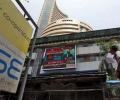
The 30-share bluechip index is rebalanced on a semi-annual basis with next rejig slated for June 18.

While the stocks met various other inclusion parameters, there were fears they may still get disqualified given the sharp run up in their stock prices.

Over the weekend, many companies stepped in to ease the bottleneck in supply and transportation of oxygen, as demand ran high with the surge in cases.
 © 2026 Rediff.com - Investor Information - Advertise with us - Disclaimer - Privacy Policy - Sitemap - Feedback - About us - Terms of use - Grievances